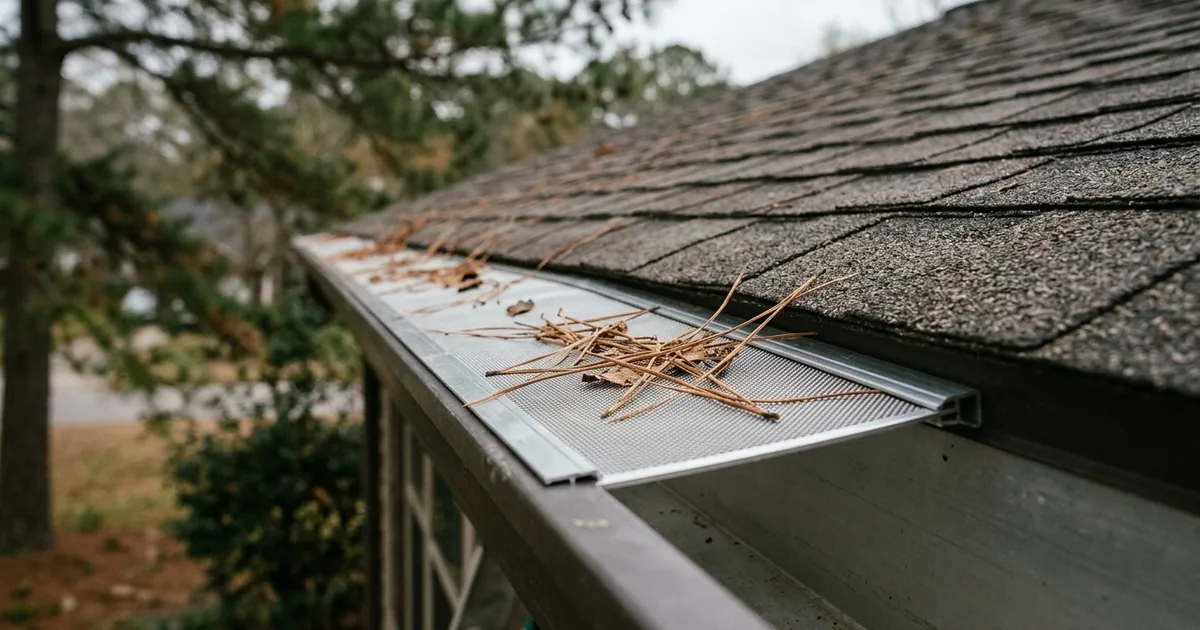

Which Gutter Guards Actually Work Against Pine Needles?
Micro-mesh gutter guards are the only style that reliably stops pine needles. Openings in the 440 to 990 micron range are small enough that needles cannot pass through and cannot wedge into the surface. Reverse-curve, screen, and brush guards all let pine needles through or trap them, which produces a mat that blocks water as thoroughly as a clogged gutter.
TLDR:
- The scale of the problem: 31% of homeowners report pine needle clogs in their gutters (This Old House, 2026)
- Why needles are different: they are thin enough to slip through wide guards, then tangle with other debris into dense mats
- What works: micro-mesh with 440 to 990 micron apertures prevents the matting that defeats foam and screen guards
- What does not: reverse-curve and brush style guards perform poorly against pine specifically
- Installed cost: homeowners buying from top rated providers paid an average of $11.67 per linear foot for professional installation (This Old House, 2026)
- Premium range: micro-mesh guards typically run $12 to $20 per foot installed
South Louisiana yards are full of loblolly and slash pine. They shed year round rather than in one tidy autumn drop, which means a gutter under pine is never done filling. Homeowners in Denham Springs, Walker, Central, and the wooded parts of Baton Rouge deal with this every season.
Pine needles are also the single hardest debris type for a gutter guard to handle. Understanding why explains which products are worth buying.
Under heavy pine and tired of the ladder? We will look at your roofline and tree cover and tell you which guard style your house actually needs.
Why Do Pine Needles Defeat Most Gutter Guards?
The shape of a pine needle is the entire problem.
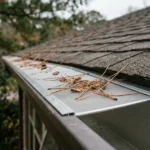
Pine needles are long, thin, and stiff. That geometry lets them slip through openings wide enough to pass leaves, then tangle with each other and with grit into dense mats that clog gutters and downspouts (Clean Pro Gutter Cleaning, 2026). A leaf either passes or it does not. A needle does something worse: it lodges halfway.
Once a mat forms on top of a guard, water sheets over the edge instead of draining. The gutter is technically clean and functionally useless.
The Guard Styles That Struggle
Reverse-curve guards rely on water clinging around a curved nose while debris falls past. Pine needles are light enough to ride the water around the curve and into the trough.
Brush guards, the bottle brush inserts that sit in the gutter, catch needles in the bristles. Screen guards with wide mesh let needles through the same way a colander passes rice. Foam inserts collect needles on the surface and hold moisture against them.
Micro-mesh guards are the exception because the opening is smaller than the needle is thick.
What Aperture Size Do You Actually Need?
This is the specification that separates products that work from products that look similar.
Micro-mesh guards with apertures in the 440 to 990 micron range prevent the pine needle matting and interlocking that causes foam and screen guards to fail. Anything meaningfully wider passes needles. A stainless steel mesh bonded to a rigid frame holds that opening size over time rather than deforming under load.
Ask for the aperture specification in microns before you buy. If a contractor cannot tell you the number, that is informative on its own.
Ask for the aperture in microns before you buy. We are happy to walk your gutters and show you what is actually landing in them.
Frame and Fastening Matter Too
The mesh is only half the product. A guard that sags, lifts at the seams, or gets fastened under the shingle course can fail regardless of aperture.
In a climate with heavy rain bursts, the frame needs to hold the mesh flat under a sheet of water and stay attached during storm winds. Ask how the system attaches, and whether it requires lifting roof shingles, which can affect a roofing warranty. Our completed project gallery shows how the systems sit on a finished roofline.
What Do Gutter Guards Cost in Louisiana?
Pricing spreads widely, and the spread mostly tracks product type rather than region.
| Option | Typical installed cost per linear foot |
|---|---|
| Average paid, top rated providers | $11.67 |
| Premium micro-mesh | $12 to $20 |
| High end branded systems | $18 to $40 |
| DIY materials only | $2.50 to $4.00 |
A 150 to 200 linear foot home in a self install project runs roughly $375 to $800 in materials (DG Floors, 2026). Professional installation of micro-mesh on the same home lands well above that, and the difference buys correct pitch, secure fastening, and a workmanship warranty.
The honest way to evaluate cost is against what you spend now. If you are paying for gutter cleaning two or three times a year because of pine, the guard math changes quickly.
What Guards Do Not Do
No gutter guard makes a gutter maintenance free, and any contractor promising that is overselling.
Micro-mesh keeps debris out of the trough, but fine grit and pollen still accumulate on top of the mesh, and that surface needs occasional rinsing. Under heavy pine, expect to clear the mesh surface once or twice a year. That is a very different job from scooping a packed gutter from a ladder.
If your gutters are undersized or pitched poorly, a guard will not fix overflow. That is a gutter problem wearing a guard problem costume, and it is usually solved by seamless gutter installation rather than by a screen on top of the old system.
Get a straight answer on gutter guards. We will tell you plainly whether your tree cover justifies them, including when the honest answer is that it does not.
Common Questions About Gutter Guards and Pine Needles
Here are the questions homeowners under pine trees ask most often before committing to a system.
Do Gutter Guards Work With Pine Needles at All?
Micro-mesh guards do. Guards with wider openings generally do not, because pine needles are thin enough to pass through or wedge in. The distinguishing specification is aperture size, and the effective range for pine is roughly 440 to 990 microns. Reverse-curve, brush, and foam styles are the ones that most often disappoint homeowners with pine trees.
How Often Do I Still Need to Clean Gutters With Guards Installed?
Expect to rinse the mesh surface once or twice a year under heavy pine cover. Guards stop debris from filling the trough, but pollen, grit, and needle fragments still collect on top of the mesh. That surface cleaning is far faster and safer than removing packed debris from inside the gutter, but it is not zero maintenance.
Are Gutter Guards Worth the Cost in Louisiana?
For homes under pine or heavy tree cover, usually yes. Compare the installed cost against what you currently spend on two or three cleanings a year plus the water damage risk from repeated overflow. For a home with minimal tree cover, the payback period stretches out and guards become more of a convenience purchase than a necessity.
Will Gutter Guards Void My Roof Warranty?
They can, if installation requires lifting shingles to secure the guard under the roofing course. Ask any contractor how their system attaches before work begins, and check your roofing warranty terms. Systems that fasten to the gutter itself rather than under the shingles avoid the question entirely.
What Is the Best Gutter Guard Aperture for Pine Needles?
A micro-mesh opening between roughly 440 and 990 microns is the effective range. That is small enough to block pine needles and the fine debris that mats with them, while still passing water at the volume a Louisiana downpour delivers. Ask for the specification in microns rather than accepting a general description like “fine mesh.”