
Do Louisiana Gutters Need Winter Prep?
Yes, but not the snow-country kind. South Louisiana gets freezing nights most winters and only rarely gets a day that stays below freezing. When one comes, any water sitting in a gutter turns to ice. Winter prep here means getting the water out: clear the debris, fix low spots, reseal leaking joints and keep downspouts draining before late November.
TLDR:
- Baton Rouge averages 18.4 nights a year at or below 32 °F, mostly December through February
- A day that stays at or below freezing averages only 0.2 a year there
- January 2025 brought 7.6 inches of snow and a 7 °F low to Baton Rouge
- Ice forms where water already sits: clogs, low spots, outlets and elbows
- Frozen water weighs about as much as liquid water, and it cannot drain
- The median first freeze at the Baton Rouge airport is November 26
Most of the winter gutter advice online is written for places with snow on the roof for months. That is not a normal winter for homes in Baton Rouge, Denham Springs, Walker or Livingston.
What we do get is a long, wet fall, gutters loaded with pine needles and oak litter, and every few years a cold snap that stays below freezing for a day or more. The prep that matters here is simple, and it is mostly the same work that keeps gutters draining the rest of the year.
Want your gutters checked before the first freeze? We look for the clogs, low spots and leaking joints that hold water, and give you a clear quote up front.
To see why the prep is about water and not ice, start with how often it actually freezes here.
Cold Nights Are Common. Freeze Events Are Not.
There is a big gap between a frosty morning and a real freeze event. Climate data for Baton Rouge shows how big.
NOAA’s 1991 to 2020 climate normals for the Baton Rouge airport count an average of 18.4 nights a year with a low at or below 32 °F. Only 0.6 nights a year reach 20 °F or colder. And a day when the high also stays at or below freezing averages just 0.2 a year, or roughly one every five years.
So a frost on the windshield is normal. A day that never thaws is not. That second kind of day is the one that matters for gutters, and the record shows it does come.
What a Real Freeze Event Looks Like Here
Rare does not mean never. Two long freezes reached Baton Rouge in the last five years.
In January 2025, NOAA’s Climate.gov event tracker reported that Baton Rouge recorded 7.6 inches of snow on January 21, its snowiest day since records began in 1892. The next morning the airport hit 7 °F, its coldest reading since airport records began in 1930.
Four years earlier, the National Weather Service’s arctic outbreak history for southeast Louisiana describes February 14 to 17, 2021, as a widespread arctic outbreak with lows in the 20s, when Baton Rouge had multiple days that stayed below freezing.
The same NWS record goes back further. In December 1983, Baton Rouge had more than 60 consecutive hours below freezing. In December 1989, temperatures stayed below 32 °F from the night of the 21st until the afternoon of the 24th.
| Event | What the record shows for Baton Rouge |
|---|---|
| January 21 to 22, 2025 | 7.6 in of snow in one day, then a 7 °F low |
| February 14 to 17, 2021 | Multiple days that stayed below freezing |
| December 22 to 25, 1989 | Below 32 °F from the 21st to the 24th, low of 8 °F |
| December 24 to 25, 1983 | More than 60 consecutive hours below freezing |
The pattern is the same each time: a long stretch below freezing, not a single cold morning. That length is what gives standing water time to freeze solid.
Why a Freeze Is a Water Problem First
A dry, clean gutter has nothing to freeze. Ice only forms where water is already sitting when the cold arrives.
Water also takes up more room as it freezes. The USGS water density guide says ice is about 9 percent less dense than liquid water, which is why ice floats. That same water, trapped in a sealed end cap or a packed elbow, pushes outward on the metal and the sealant around it as it freezes.
Weight is the other half. USGS lists liquid water at about 62.4 pounds per cubic foot, and ice is roughly 90 percent of that, so a section of gutter holding ice is carrying nearly the same load as one full of water. The difference is that the ice cannot drain, so the hangers hold that load until it thaws.
That is also why heavy-ice regions hang gutters tighter. The Amerimax metal gutter installation guide calls for one hanger every 24 inches, or every 18 inches in heavy ice and snow areas. Here, the simpler fix is making sure the water is gone before the cold comes.
So the real question is where water sits in your gutter system after a rain.
Where a Freeze Finds Water in a Gutter System
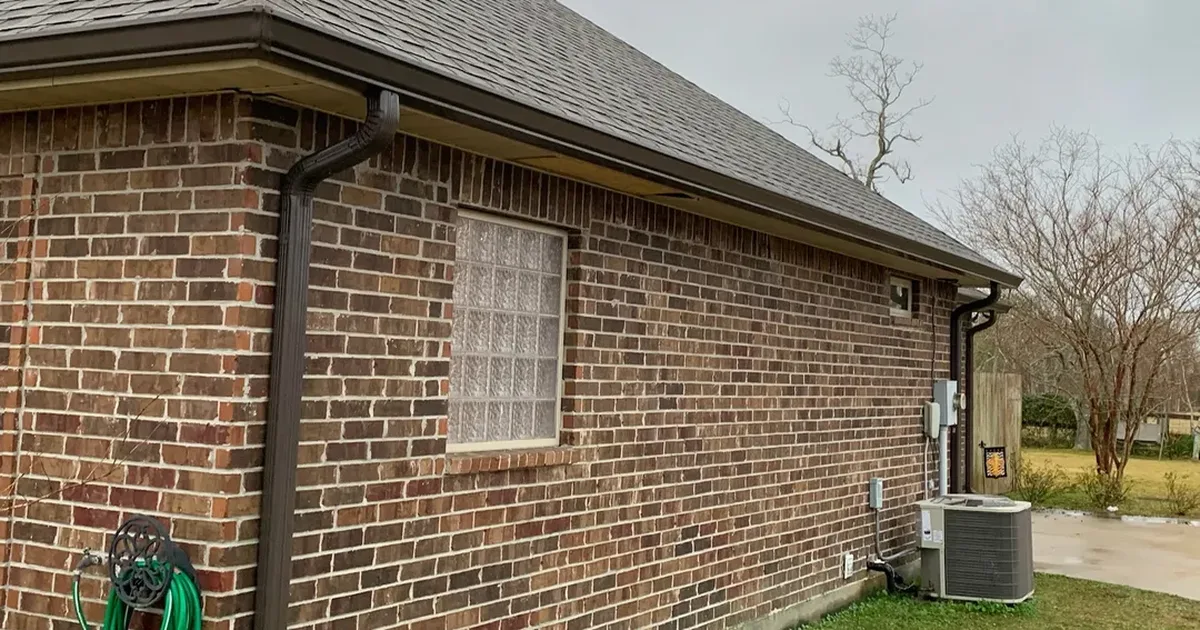
On most homes, the same few spots hold water. Each one is easy to check from the ground or a short ladder.
- Leaves and needles. A clump of debris acts like a dam. Water pools behind it after every rain.
- Low spots and sag. The common install slope is about a quarter inch of fall every 10 feet, per the same Amerimax installation guide. A small belly cancels that, and water stands in it.
- Seams, miters and end caps. These are sealed joints. Old, cracked sealant lets water seep in and out.
- The outlet and elbows. This is the narrowest path out of the system, so debris collects there first.
- Extensions and splash blocks. If the ground end is buried, crushed or pointed at a low spot, water backs up into the downspout.
- Hoses and outdoor faucets. Not part of the gutter, but on the same wall. LSU AgCenter’s 2021 cold-snap guidance says to bring water hoses indoors and use insulating covers on outdoor faucets.

Every one of those spots is fixed the same way: get the water moving. Here is the order we would do it in.
A Winter Gutter Prep Checklist for Before Thanksgiving
Timing matters more than effort. The Baton Rouge normals put the median first freeze on November 26, and there is a 1 in 10 chance of one by November 7.
That lines up with the leaf drop. Our guide to fall leaf load in Louisiana covers when pine needles and hardwood leaves usually come down, which is why one cleaning in early fall may not be the last one.
Here is the checklist, in order, with what each step prevents.
| Step | What to do | What it prevents |
|---|---|---|
| 1 | Clear leaves and needles from the troughs and outlets | Dams that hold water behind them |
| 2 | Flush each downspout with a hose and watch it drain | Packed elbows that freeze solid |
| 3 | Sight down each run for dips and sag | Standing water in low spots |
| 4 | Look for drips or stains at seams, miters and end caps | Water seeping into joints before a freeze |
| 5 | Check that hangers are tight and the fascia is solid | A loaded gutter pulling away |
| 6 | Make sure extensions point away from the house and are not buried | Water backing up into the downspout |
| 7 | Bring hoses in and cover outdoor faucets | Frozen hoses and fixtures on the same wall |
Steps 1 and 2 are the ones most homeowners can do on their own. Steps 3 through 5 are where a repair is often needed, because a sag or a leaking joint does not fix itself with a cleaning.
If a run keeps sagging in the same place, our guide to long seamless gutter runs explains how hanger spacing and slope work together.
Found a sag, a drip or a downspout that will not drain? Those are repairs, not cleanings. We fix the low spot, reseal the joint or clear the outlet, and tell you plainly what it needs.
The checklist covers before. The other half is knowing what to look at once a freeze has passed.
What to Check After a Freeze
After a real freeze event, the damage, if any, shows up when the ice melts. Walk the house on the first warm afternoon and during the next good rain.
- Gutters that pulled away. Look for a gap between the gutter and the fascia, or hangers that tilt.
- New drips at joints. A seam or end cap that was dry before and drips now likely took some stress.
- Downspouts that do not drain. If water backs up and spills over the top, an elbow may still be packed.
- Bent or split sections. A split in the bottom of a trough or a crushed elbow calls for a repair, not a cleaning.
- Water at the foundation. If extensions were knocked loose by ice or foot traffic, put them back.
Do not knock ice out of a gutter with a hammer or pry it loose. Let it melt. Banging on frozen metal can dent the gutter and loosen the hangers you are trying to protect.
If what you find looks like more than a quick fix, our guide to repairing or replacing an aging gutter system walks through how to tell the difference.
What Baton Rouge Homeowners Ask About Gutters and Freezing Weather
These are the questions that come up when a hard freeze is in the forecast. The short answers point back to the sections above.
Do gutters freeze in Louisiana?
They can, but only where water is sitting when a long freeze arrives. Baton Rouge averages 18.4 nights a year at or below 32 °F, per NOAA’s 1991 to 2020 normals, but most thaw by afternoon. A gutter that drains clean has little to freeze. Clogs, sags and packed downspouts are where ice forms.
Do I need to winterize my gutters in Baton Rouge?
Not the way snow-country guides describe. The prep that matters here is clearing debris, flushing the downspouts, fixing low spots and resealing leaking joints before late November, when the median first freeze arrives at the Baton Rouge airport.
Can ice damage my gutters?
It can. Ice is about 9 percent less dense than water, per USGS, so it takes up more room than the water it came from. Trapped in a sealed joint or a packed elbow, it pushes outward. A gutter full of ice also carries nearly the weight of a gutter full of water, and it cannot drain until it thaws.
When is the first freeze in Baton Rouge?
NOAA’s 1991 to 2020 normals for the Baton Rouge airport put the median first freeze at November 26 and the median last freeze at February 25. There is a 1 in 10 chance of a first freeze by November 7, so early November is a good time to finish gutter prep.
Should I remove ice from my gutters?
No. Let it melt on its own. Chipping or prying at frozen gutters can dent the metal, crack the sealant and loosen hangers. Once it thaws, check for gaps at the fascia, new drips at joints and downspouts that still do not drain, then fix what you find.
What should I do with hoses and outdoor faucets before a freeze?
LSU AgCenter’s 2021 cold-snap guidance says to bring water hoses indoors and to use insulating covers on outdoor faucets. A hose left connected holds water against the faucet. It is a small job that sits on the same wall as your downspouts, so do both on the same walk.
Get the Water Out Before the Cold Comes In
A freeze event in South Louisiana is rare, but it does not give much warning, and it does not need much water to cause a problem. A gutter that drains clean in November is a gutter with nothing to freeze in January.
Performance Patios and Gutters is a firefighter-owned company with over 12 years of experience on homes across Baton Rouge, Denham Springs, Walker and Livingston Parish. You can see some of that work in our project gallery. Our gutter repair service in Baton Rouge covers the fixes that keep water moving: sags, leaking joints, loose hangers and blocked downspouts.
Get ahead of the first freeze. Ask for a free, no-pressure gutter assessment. We will check the runs, joints and downspouts, and tell you plainly what needs work and what does not.