
What Happens to a Seamless Gutter Run Over 40 Feet?
A seamless aluminum gutter grows and shrinks with temperature. A 40-foot run moves about 5/16 of an inch across a normal Baton Rouge year, and more in full sun. Past roughly 40 to 50 feet, that movement, the slope and the water load all get harder to manage, so a long run is usually split at a high point with a downspout at each end.
TLDR:
- A 40 ft aluminum run grows about 5/16 inch between a normal winter low and summer high here
- In full sun the swing can roughly double, and the movement piles up at the fixed points
- SMACNA treats 50 ft as a practical maximum length for one downspout, to limit expansion
- Long runs are usually split at a high point, or broken with an expansion joint
- The common manufacturer spacing is one hanger every 24 inches, with no slack for gaps
- At ¼ inch per 10 ft, a 40 ft run has only 1 inch of fall, so a small sag can stop the drain
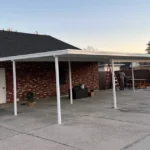
Long walls are common around Denham Springs: ranch homes, wide carports and patio covers that run the full back of the house. Those are the walls where one continuous piece of seamless gutter in Denham Springs looks cleanest.
They are also the walls where the details catch up with you. Summer sun heats the metal, and NOAA’s 1991 to 2020 climate normals put 61.94 inches of rain a year on Baton Rouge. A long run has to be planned, not just hung.
Have a long wall that needs gutters? We measure the run, plan where the high point and downspouts go, and give you a clear quote up front.
The first thing to plan for is the one most people never think about: the gutter moves.
Why a Long Aluminum Gutter Moves
Metal gets longer when it warms and shorter when it cools. On a 10-foot section you would never notice. On a 40-foot seamless run, that small change per inch adds up along the whole length.
The rate is well documented. The Engineering ToolBox table of metal expansion coefficients lists aluminum alloy 3003 at 12.9 millionths of an inch per inch for every degree Fahrenheit, and the other aluminum alloys it lists fall between 12.8 and 13.2.
The temperature swing is local. NOAA’s monthly normals for the Baton Rouge airport show a normal January low of 41.6 °F and a normal August high of 92.2 °F. That is about a 50-degree gap in the air, and gutter metal in afternoon sun runs hotter than the air around it.
Put those together on a 40-foot run: 480 inches, times 12.9 millionths, times 50 degrees, comes to about 0.31 of an inch. That is roughly 5/16 of an inch. Double the swing for a sun-baked south or west wall, and it is closer to 5/8.
The exact number matters less than the pattern. Movement grows with length, so a run twice as long moves twice as far, and it all has to go somewhere.
How Far Each Run Length Moves
Here is the same math for the run lengths we see most, with the total slope each run gets at a quarter inch of fall per 10 feet. The slope column comes back later, when we get to sag.
| Run length | Movement, 50°F swing | Movement, 100°F swing | Total fall at ¼ in per 10 ft |
|---|---|---|---|
| 20 ft | about 1/8 in | about 5/16 in | ½ in |
| 40 ft | about 5/16 in | about 5/8 in | 1 in |
| 60 ft | about 7/16 in | about 15/16 in | 1½ in |
| 80 ft | about 5/8 in | about 1¼ in | 2 in |
Past 40 feet, the movement passes a quarter inch even on a mild year, while the slope stays thin. So where does the movement go?
Where the Movement Goes
A seamless run is fastened along its whole length, so the movement does not vanish. It shows up at the points that cannot slide.
Those points are the sealed end caps, the corner miters, the outlet where the downspout drops, and every hanger along the way. Each warm afternoon and cool night works them a little. These are the spots we check first on an older long run, because they are where movement and water meet:
- Sealant cracked or pulled away at the end caps and inside corners
- A drip line or stain on the fascia below a corner or outlet
- Hangers that have backed out, tilted or left a gap at the fascia
- A front edge that no longer runs straight when you sight down it
Spotting the wear is half of it. The other half is designing a long run so less metal moves as one piece.
Splitting a Long Run: High Point or Expansion Joint
You cannot stop aluminum from moving. You can shorten the length that moves together, and you can give the water a shorter trip at the same time.
The SMACNA downspout and gutter calculator, built on the Architectural Sheet Metal Manual, 7th edition, treats 50 feet as a practical maximum gutter length for one downspout, to limit the effects of thermal expansion. Our guide to downspout sizing covers the drainage side of that same limit.
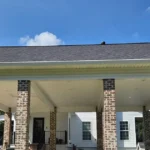
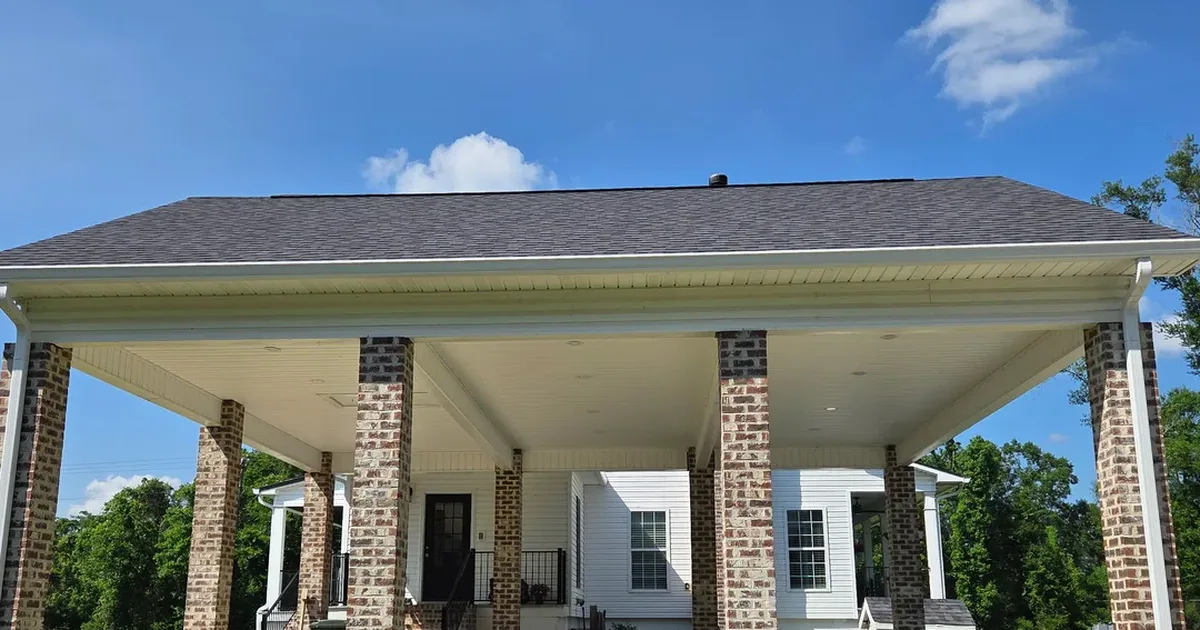
Option 1: a high point in the middle. The run is set highest near its center and slopes both ways, to a downspout at each end. Each half is half as long, so it moves about half as much and carries half the water. The carport at the top of this page is a long run with a downspout at each end.
Option 2: an expansion joint. Two gutter sections meet at a joint built to flex. U.S. Patent 9,963,881, granted in 2018, describes one made of a resilient material that allows for the expansion and contraction of two adjacent gutter ends. A joint makes sense when the water cannot split, such as a wall with only one spot where a downspout can drain away from the house.
On most long walls, the high point is the simpler answer, because it fixes the movement and the drainage with one decision.
Not sure where your long run should split? We look at the wall, the roof above it and where the water can safely go, then lay out the high point and outlets before the gutter goes up.
Once the layout is set, the hangers decide how well the run holds its shape.
Hanger Spacing on a Long Run
Every hanger carries a share of the gutter, the debris and the water. On a long run, there is no spare length to hide a wide gap.
The Amerimax installation guide for metal gutter systems calls for one hanger every 24 inches, or every 18 inches in heavy ice and snow areas. We do not get much ice here, but we do get heavy rain and gutters loaded with pine needles and oak litter.
| Run length | Hangers at 24 in spacing | Hangers at 18 in spacing |
|---|---|---|
| 20 ft | about 10 | about 14 |
| 40 ft | about 20 | about 27 |
| 60 ft | about 30 | about 40 |
A few extra hangers on a long run cost little next to rehanging a sagging one.
Spacing only works if each hanger bites into sound wood. If a run keeps sagging in the same spot after it is rehung, our guide to fascia rot from gutters explains why the board behind it is usually the real problem. That brings us to sag itself.
Why Long Runs Sag
A gutter sags when the load at one spot beats the hangers and the wood holding them. Long runs collect more load, and they have less slope to spare.
The same Amerimax guide sets the slope at about a quarter inch of fall for every 10 feet, toward the downspout. On a 40-foot run, that is only 1 inch of fall from end to end. A belly of half an inch in the middle cancels half of it, and water stands in the low spot after the rain stops.
Standing water is heavy. The USGS water density table puts a cubic foot of water at about 62.4 pounds. That weight, plus the wet debris it collects, lands on the same few hangers, which pulls the belly lower. A sag tends to feed itself.
The usual causes are easy to list:
- Hangers spaced too far apart for the load
- Hangers set in fascia that has gone soft
- A run that was never pitched evenly, or lost its pitch
- Ladders leaned against the gutter or branches resting on it
Most of these show up from the ground, if you know where to look.
What to Check From the Ground
You do not need a ladder to spot a long run in trouble. Walk it once after a good rain and once on a hot afternoon.
- Sight down the run from one end. The line should fall steadily, with no dip.
- After rain, look for drips along the front edge, at the end caps and at the corners.
- Check the fascia under corners and outlets for stains or soft paint.
- Note where water spills over in a downpour. Overflow at the far end of a long run often points to too few downspouts or too little slope.
- Look for hangers that stick out, tilt or leave a gap at the fascia.

If you find a dip or a steady drip, the fix is usually smaller the sooner it is caught. The questions below are the ones we hear most about long runs.
What Denham Springs Homeowners Ask About Long Gutter Runs
These questions come up most on long walls, wide carports and full-length patio covers around Denham Springs and Baton Rouge. The short answers below point back to the sections above for the detail.
How long can a seamless gutter run be?
There is no fixed limit on how long seamless gutter can be formed. The practical limit is movement and drainage. SMACNA treats 50 feet as a practical maximum length for one downspout, to limit thermal expansion. Past about 40 to 50 feet, the usual answer is a high point with a downspout at each end.
Do seamless gutters need expansion joints?
Short runs rarely do. A long run calls for either a split at a high point, with each half draining to its own downspout, or an expansion joint between two sections. Both do the same job: they shorten the length of metal that moves as one piece, so less stress builds at the ends.
How much does an aluminum gutter expand?
Engineering ToolBox lists aluminum alloy 3003 at 12.9 millionths of an inch per inch for each degree Fahrenheit. On a 40-foot run, a 50-degree swing, close to Baton Rouge’s normal gap between a January night and an August afternoon, works out to about 5/16 of an inch. Full sun can double that.
How far apart should gutter hangers be?
Amerimax’s installation guide calls for one hanger every 24 inches, or every 18 inches in heavy ice and snow areas. On a 40-foot run, that means about 20 hangers. Spacing only works if every hanger sits in sound fascia, so soft wood has to be fixed before the gutter is rehung.
Why is my long gutter sagging in the middle?
Usually it is one of three things: hangers spaced too far apart, hangers set in fascia that has gone soft, or a run that lost its slope so water stands in it. Water weighs about 62.4 pounds per cubic foot, per USGS, so a low spot that holds water tends to sag further.
Can a sagging long run be rehung, or does it need replacing?
Often it can be rehung, if the metal is straight, the seals are sound and the fascia is solid. If the gutter is kinked, leaking at several joints or hung on rotted wood, replacement can make more sense. Our guide to repairing or replacing an aging gutter system walks through how to tell.
Plan the Long Run Before It Goes Up
A long run is easiest to get right before the gutter is formed. Once it is on the wall, every fix means working around a piece that is already in place.
Performance Patios and Gutters is a firefighter-owned company with over 12 years of experience on homes across Denham Springs, Baton Rouge and Livingston Parish. For long walls in the city, our seamless gutter installation in Baton Rouge starts with the same plan: where the high point goes, where the downspouts drop and how the hangers are spaced.
Long wall, one question: where does the water go? Get a free, no-pressure assessment. We will measure the run, mark the high point and downspouts, and tell you plainly what it needs.