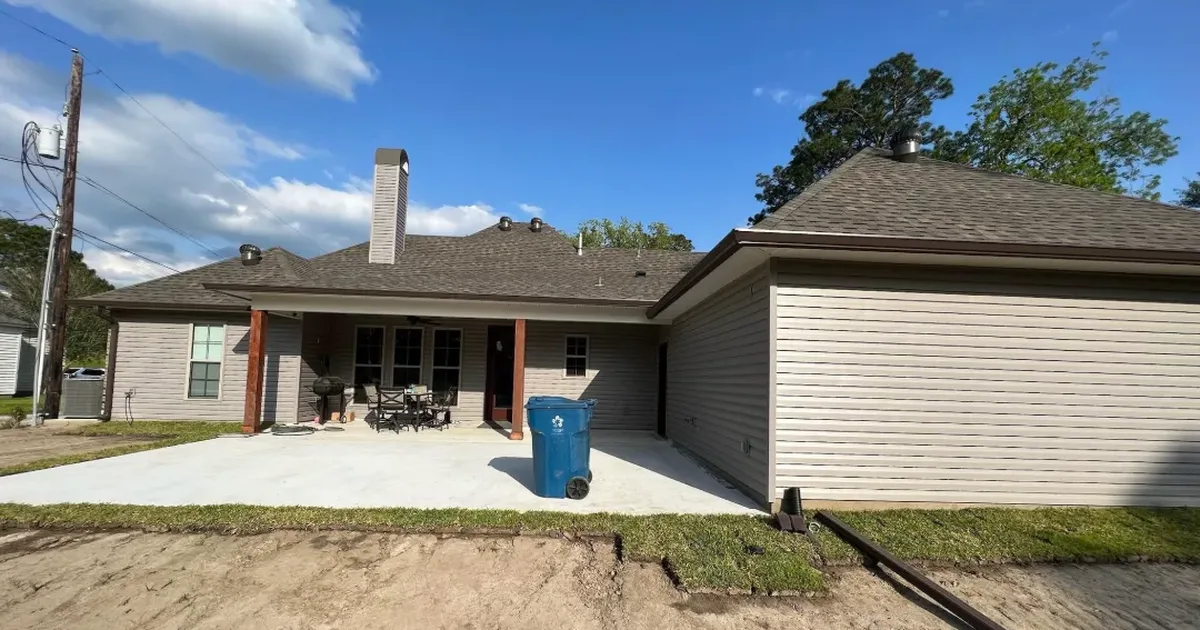

How Livingston Parish Soil and Rainfall Shape a Patio, Cover and Gutter Build
Plan for water first. NOAA’s Livingston station averages 67.76 inches of rain a year, and several soils first described in the parish hold water within about 2 feet of the surface from December through April. That means a patio slab needs real slope and a firm base, cover posts need a plan for wet ground, and gutters must carry roof water well away from both.
TLDR:
- Livingston’s NOAA station averages 67.76 inches of rain a year, about 6 inches more than Baton Rouge’s airport
- Its normals show about 21.5 days a year with an inch of rain or more, and 7 days with 2 inches or more
- USDA soil descriptions put the wet-season water table at 0.5 to 2.5 feet in several parish soil series
- Some local soils carry smectitic clay, the type that swells when wet and shrinks when dry
- The code calls for paved surfaces near the house to slope at least 2 percent away from it
- Every inch of rain on a 2,800 square foot roof is about 1,743 gallons that has to go somewhere
From Denham Springs and Walker out to Watson and Livingston, a covered patio is one of the most common projects homeowners here ask about. It is also a parish that knows water better than most. In August 2016, the U.S. Geological Survey’s report on the flood records over 31 inches of rain in Watson.
You do not need a flood to have a water problem out back. Ordinary rain on slow-draining ground is enough to crack a slab, settle a post or pond water against the house. The good news is that the soil and rain data for the parish is public, and it tells you what to plan for before anyone pours concrete.
Planning a patio, cover or gutters in Livingston Parish? We will look at your yard, your soil and where the water goes before we quote anything.
What Kind of Soil Sits Under Livingston Parish Yards?
Several soil series were first described right here, and the USDA’s records for them read like a map of the parish. They describe silty and clayey soils on old, nearly level to gently sloping terraces, and every one of them drains slowly.
The Springfield series was established in Livingston Parish in 1931, with its type location about half a mile southwest of Frost. The USDA describes it as poorly drained with slow permeability, and an apparent water table “within 0 and 2 feet of the surface December through April.”
The Verdun series, also established in Livingston Parish in 1931, is somewhat poorly drained and “very slowly permeable,” with sodium in the subsoil. Its seasonal water table is perched just 0.5 to 1.0 feet down from December through April.
Here is how those compare with three other series whose type locations sit in the parish:
| Soil series | Where the USDA describes it | Drainage | Wet-season water table (Dec to Apr) |
|---|---|---|---|
| Verdun | Established in Livingston Parish, 1931 | Somewhat poorly drained | 0.5 to 1.0 ft |
| Springfield | Near Frost | Poorly drained | 0 to 2 ft |
| Encrow | About 4.5 miles southeast of Walker | Poorly drained | 0 to 1.5 ft |
| Satsuma | About 1.75 miles southeast of Watson | Somewhat poorly drained | 1.0 to 2.5 ft |
| Colyell | About 1.25 miles southeast of Verdun | Somewhat poorly drained | 1.0 to 2.5 ft |
The Encrow, Satsuma and Colyell descriptions all place their type locations in Livingston Parish. Read down the last column and the pattern is plain: for five months a year, water sits close under a lot of yards here.
Which soil sits under your lot changes street by street. The USDA’s free Web Soil Survey maps the soil for any address, and it is worth five minutes before a big outdoor project.
Why Clay Type Matters for a Patio Slab
Wet soil is one problem. Soil that moves is another, and some Livingston Parish clays do both.
The USDA classifies both Colyell and Encrow as “fine, smectitic” soils. Smectite is a clay mineral, and the USGS explains in its smectite group reference that the bonds between its layers are weak, which lets water in and causes the clay to expand. Its overview of clay minerals adds that buildings on swelling clays “may be subject to structural damage caused by seasonal swelling.”
When the clay under one part of a slab gets wetter than the rest, it can swell unevenly and push on the concrete. That is one reason a slab can crack even when the concrete itself was mixed and cured well.
The building code treats this as a real risk. Section R401.4 of the 2021 International Residential Code lets the building official require a soil test where soil data shows expansive soils are likely. Section R403.1.8 defines expansive soil by test results, including a plasticity index of 15 or more.
None of that means a patio cannot go on clay. It means the slab plan should answer three questions up front:
- What is under the topsoil? Check the mapped soil, and dig a test hole where the slab will go.
- How will water leave the slab? The same chapter’s drainage section calls for paved surfaces within 10 feet of the house to slope at least 2 percent away from it.
- Where does roof water land? Downspouts that empty at a slab edge keep the clay under that edge wetter than the rest.
For thickness, joint spacing and curing, our guide to patio concrete pouring goes through each step. Getting the ground right comes first, because no slab is stronger than the soil carrying it.
Not sure what is under your yard? We will check the soil, the slope and the water path before planning your patio concrete in Livingston Parish.
How Much Rain Falls in Livingston Parish?
More than in Baton Rouge, and it comes in big doses. The numbers below come from NOAA’s official 1991 to 2020 climate normals for stations inside the parish.
NOAA’s annual normals for the Livingston station show 67.76 inches of rain a year. The Denham Springs station normals show 64.32 inches. For comparison, the Baton Rouge airport normals come in at 61.94 inches.
The heavy days matter more than the total, because that is when gutters overflow and yards flood:
| Station (NOAA 1991 to 2020) | Rain per year | Days with 1 inch or more | Days with 2 inches or more |
|---|---|---|---|
| Livingston | 67.76 in | 21.5 | 7.0 |
| Denham Springs | 64.32 in | 20.6 | 6.6 |
| Baton Rouge airport | 61.94 in | 19.2 | 6.2 |
Read across the rows and Livingston Parish gets a couple more big rain days a year than Baton Rouge. Over the life of a patio, that adds up to a lot of extra water.
The timing is the part that catches people. NOAA’s monthly normals for Livingston add up to about 27 inches from December through April, by our math. Those are the same months the soil descriptions above give for a high water table, so winter rain lands on ground that is already full.
What the Rain and Soil Mean for a Patio Cover
A patio cover concentrates its weight on a few posts, and each post has to sit on ground that will not soften under it. The code sets out two ways to carry those posts.
Appendix AH of the 2021 International Residential Code allows a patio cover on a slab without separate footings only where the frost depth is zero. Even then, the slab has to be at least 3.5 inches thick and each column can carry no more than 750 pounds. Bigger loads call for real footings.
Appendix AH is an optional part of the code, and the Louisiana State Uniform Construction Code Council’s adoption list names the 2021 residential code but not its appendices, so ask your permit office which rules apply. Either way, the soil under each post matters. The code’s presumptive load-bearing table in the same foundations chapter gives clay soils 1,500 pounds per square foot, the lowest value listed.
On wet ground, a few habits protect a cover for the long run:
- Keep water off the post bases. Do not let a gutter outlet or downspout empty next to a post.
- Let the slab fall away from the house. Water under the cover should run out, not back toward the wall.
- Plan the cover’s own drainage. A cover adds roof area, so it adds water. Our guide to patio cover gutters shows where that water should go.
If you are weighing an insulated or open cover for a Livingston Parish home, our patio cover installation in Livingston starts with the slab and soil, not the roof panels.
Sizing Gutters for Livingston Parish Rain
Every inch of rain on a roof becomes a lot of water at one spot on the ground. The USGS Water Science School works the math for a 40 by 70 foot roof: one inch of rain sheds about 1,743 gallons.
On one of Livingston’s seven or so 2-inch days a year, that same roof sheds roughly 3,500 gallons. Add a patio cover and the roof gets bigger, so the total grows with it.
Here is what that means for the gutters:
- Size for the burst, not the average. Gutters fail in the heaviest few minutes of a storm, so outlets and downspouts need room to spare.
- Add downspouts instead of overloading a few. More outlets split the flow into smaller streams the soil can handle.
- Carry the water out. On slow-draining ground, discharge should end well away from the slab, the cover posts and the foundation.
- Use fewer seams. Seamless runs leave fewer joints to leak onto a slab edge or a post base.
Our seamless gutter installation in Livingston and downspout installation for Livingston homes are built around where the water ends up, not just how the gutter looks on the fascia.
Flood History: Elevation and Drainage Are Two Separate Questions
The August 2016 flood is part of every building conversation in this parish. The National Weather Service flood summary describes 20 to 30 inches of rain from August 11 through 13, and lists Livingston Parish among the areas with the most widespread flooding.
The USGS report on the same event notes peak streamflows of record at 10 gauges, with flooding along the Amite, Comite, Tickfaw and other rivers. River flooding on that scale is a question of elevation and flood zone, not gutters.
Check your lot on FEMA’s Flood Map Service Center before you add a slab or a cover, and ask your permit office what applies in your zone. Then plan the everyday drainage separately, because the afternoon storms are what a patio deals with every year.
A Livingston Parish Site Checklist Before You Build
A little homework before the first quote makes the whole job go smoother. Most of it takes an afternoon.
- Look up the mapped soil for your address on Web Soil Survey.
- Check your flood zone on FEMA’s map service.
- Walk the yard an hour after a heavy rain and photograph where water stands.
- Note where every downspout empties today, and how far the water travels.
- Dig a small test hole where the slab will go, and note how wet the soil is a foot down.
- Ask your parish or city permit office what a patio cover or slab requires.
If water already collects along your foundation, our guide to standing water at the foundation in Walker covers the fixes. Bring your notes and photos to any contractor you talk to.
Common Questions About Building Patios on Livingston Parish Soil
These are the questions Livingston Parish homeowners ask when planning a patio, a cover or new gutters. The answers draw on USDA soil descriptions, NOAA rainfall normals and the International Residential Code.
How much rain does Livingston Parish get?
NOAA’s 1991 to 2020 normals put the Livingston station at 67.76 inches a year and Denham Springs at 64.32 inches, both above Baton Rouge’s 61.94. Livingston averages about 21.5 days a year with an inch or more of rain, and about seven days with 2 inches or more.
Is Livingston Parish soil good for a concrete patio?
It can carry a patio, but much of it drains slowly. USDA descriptions for several parish soils show water within about 2 feet of the surface from December through April, and some carry smectitic clay that swells when wet. Plan the slope, the base and the roof water before you pour.
Why do patios crack on clay soil?
Clay that swells when wet and shrinks when dry pushes on a slab unevenly. If one edge stays wetter than the rest, often because a downspout empties there, the soil under it moves differently. Good slope, a firm base and moving roof water away from the slab edges all reduce that stress.
Does a patio cover in Livingston Parish need footings?
It depends on the load and your local rules. The code’s patio cover appendix allows posts on a slab without footings only where the slab is at least 3.5 inches thick and each column carries no more than 750 pounds. Ask your permit office which rules apply to your project.
How do I find out what soil is under my house?
Use the USDA’s free Web Soil Survey. Enter your address, draw your lot and it shows the mapped soil series. You can then read that series’ official description for drainage and water table depth. A test hole where you plan to build confirms what the map suggests.
Build for the Ground You Have
Livingston Parish gives you more rain than Baton Rouge and soil that holds onto it. A patio built for those conditions starts with the water path, then the slab, then the cover. As a firefighter-owned company with over 12 years of experience, we plan outdoor projects across Livingston and the surrounding parish in that order, and you can see recent work in our project gallery.
Ready to plan a patio that suits Livingston Parish ground? We will walk the yard with you and give you a clear quote, with no surprises.