
Why Newer Walker Homes Still Get Standing Water at the Foundation
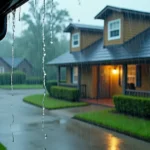
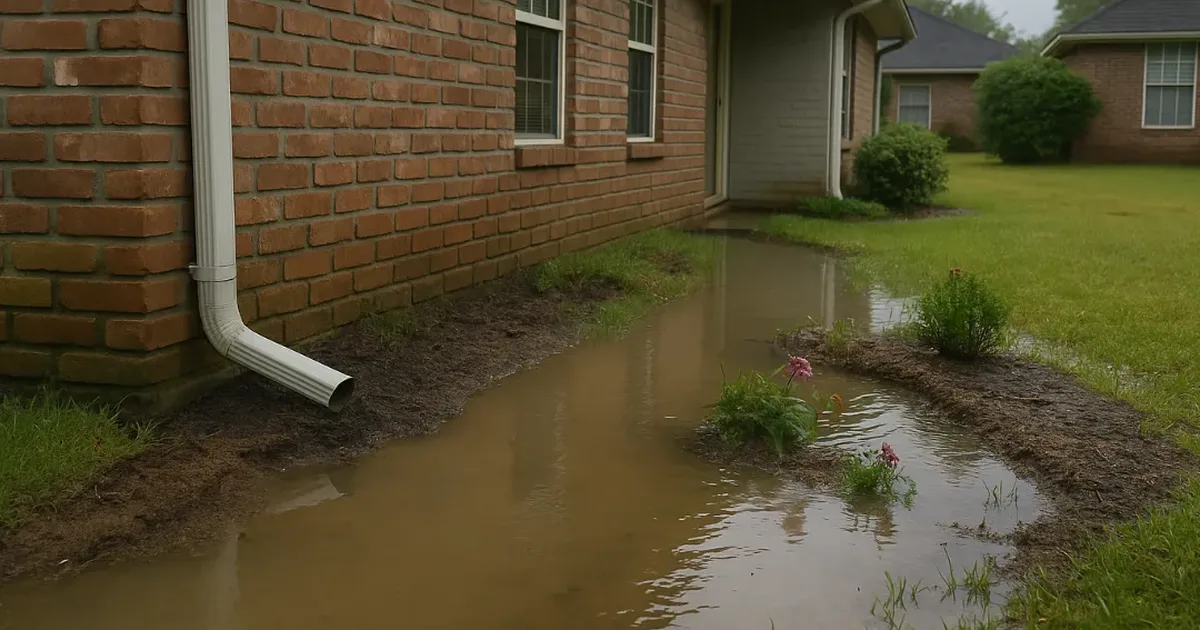
Newer Walker homes are graded to code, but the soil underneath drains slowly and most downspouts dump roof water right beside the slab. Louisiana’s building code requires the ground to fall 6 inches in the first 10 feet, yet Livingston Parish soils can hold water within a foot or two of the surface from December to April. Water left at the foundation has nowhere to go. Moving the discharge away is usually the fix.
TLDR:
- Louisiana enforces the 2021 International Residential Code, and so does Walker
- The code requires the ground to drop 6 inches in the first 10 feet from the foundation
- Common Livingston Parish soils are poorly or somewhat poorly drained, with water perched close to the surface all winter
- One inch of rain on 1,000 square feet of roof sends about 623 gallons to the downspouts
- Downspouts that end at the slab put that water exactly where the grade is weakest
- Extending or burying the downspout discharge fixes most cases; regrading fixes the rest
Plenty of Walker homes sit in newer subdivisions, with slab foundations, fresh sod and builder-installed gutters. And Livingston Parish knows water: after the August 2016 flood, a preliminary state-commissioned estimate put flood damage at 74% of Livingston Parish’s housing stock.
A new house clearing flood elevation is not the same as a lot that drains well. Elevation keeps river water out of the living space. Drainage decides where every afternoon storm goes after it runs off your roof, and that is where newer homes still come up short.
Water standing along your slab after a storm? We will find where it is coming from and where it needs to go, before we quote anything.
What Does the Code Require Around Your Foundation?
A real slope, measured from the wall out. Louisiana enforces the 2021 edition of the International Residential Code statewide, according to the Louisiana State Uniform Construction Code Council. The City of Walker’s building permit page confirms “The 2021 International Codes with Louisiana Amendments” apply to projects submitted since January 1, 2023.
Section R401.3 of the 2021 International Residential Code sets the rule: “Lots shall be graded to drain surface water away from foundation walls. The grade shall fall not fewer than 6 inches (152 mm) within the first 10 feet.” Where lot lines or other barriers make that impossible, the code calls for drains or swales instead. The same section calls for patios, walks and driveways within 10 feet of the house to slope at least 2 percent away from it.
The code also addresses the roof. Section R801.3 of the same code says that “In areas where expansive soils or collapsible soils are known to exist,” roof drainage must discharge “not less than 5 feet (1524 mm) from foundation walls or to an approved drainage system.” That rule is tied to expansive soils, but the 5-foot distance is a sensible benchmark for any slab on slow-draining ground.
The code’s next edition takes effect in Louisiana on January 1, 2027, so check with Walker’s permit office for current requirements on new work.
Why Walker’s Soil Makes Standing Water Worse
Grading moves water across the surface. The soil decides how fast it soaks in, and around Walker, the answer is slowly.
The U.S. Department of Agriculture’s official soil descriptions show the problem. The Encrow series, whose type location is about 4.5 miles southeast of Walker, is described as “Poorly drained; slow to very slow runoff; slow permeability,” with “A perched water table at a depth of 0 to 1.5 feet below the soil surface during the months of December through April.”
Nearby Livingston Parish soils are only slightly better. The Satsuma and Colyell series are both “Somewhat poorly drained,” with a perched water table 1.0 to 2.5 feet down from December through April.
When the ground is already holding water a foot or two below the surface, rain has nowhere to soak in. It spreads out across the top, and it collects wherever the grade is flattest, which is often right against the slab. Which soil sits under your lot varies street by street, and the USDA’s free Web Soil Survey will show the mapped soil for your address.
How Much Water Does One Downspout Send to Your Foundation?
More than most people picture. The Baton Rouge area averages 61.94 inches of rain a year under NOAA’s 1991 to 2020 climate normals, as reported by the National Weather Service, and the station normals for Baton Rouge’s airport average 19.2 days a year with an inch of rain or more.
An inch of rain on one square foot of roof is about 0.623 gallons. Here is what that means for a single downspout, by the roof area it drains:
| Roof area draining to one downspout | Water from a 1-inch rain | From a year of 1-inch-plus days (19.2) |
|---|---|---|
| 250 sq ft | about 156 gallons | about 3,000 gallons |
| 500 sq ft | about 312 gallons | about 6,000 gallons |
| 1,000 sq ft | about 623 gallons | about 12,000 gallons |
| 1,500 sq ft | about 935 gallons | about 18,000 gallons |
This is our own math from those rainfall figures, and it counts only the heavy-rain days. Dump even the smallest row beside the slab on poorly drained ground, and standing water after a storm is no surprise.
Not sure where your downspouts should drain? We will walk the lot with you, measure the fall, and show you where the water is going now.
Why Newer Subdivisions Have This Problem Too
A new house can meet the grading rule on the day of inspection and still hold water a few years later. These are the common reasons:
- Downspouts that end at the slab. A short elbow or splash block leaves roof water inside the first few feet, where the code expects the ground to be carrying water away.
- Beds and mulch built up against the house. Landscaping added after closing can flatten or reverse the slope the builder left.
- Settled backfill. Soil placed along the foundation during construction can settle, leaving a low strip right at the slab.
- Patios and walks poured flat or toward the house. The code’s drainage section calls for paved surfaces within 10 feet to slope away at 2 percent.
- Neighboring lots draining onto yours. Tight subdivision lots share water, and a side yard between two houses can collect both roofs.
Flood elevation does not solve any of these. The City of Walker’s homeowner permit page requires flood elevation certificates before a certificate of occupancy, which addresses how high the slab sits. It says nothing about where your roof water lands.
What Actually Fixes Standing Water at the Foundation?
Start with the roof water, since it is the easiest to control. Most cases come down to one of these, often in combination:
- Extend the downspouts. Carry the discharge out past the first several feet. Five feet or more is the code’s benchmark where soils are expansive, and a good target on slow-draining ground.
- Bury the discharge. An underground line from the downspout to a daylight outlet or approved drainage point keeps the yard usable and moves water farther. The code’s wording is that surface water go to a “storm sewer conveyance or other approved point of collection that does not create a hazard.”
- Add downspouts. Fewer downspouts draining large roof areas concentrate the flow. More downspouts split it into smaller streams.
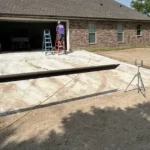
- Regrade where the slope is gone. If settling or landscaping has flattened the first 10 feet, the soil needs to be rebuilt to fall away from the wall.
Never solve your drainage by piping water onto a neighbor’s lot. The code language about a point of collection “that does not create a hazard” exists for exactly that reason. For how gutters, covers and downspouts work together, see our guide to patio cover gutters and drainage.
What to Check After the Next Heavy Rain
The best time to diagnose a drainage problem is an hour after a storm. Walk the house and look for:
- Where each downspout actually discharges, and how far the water travels before it pools
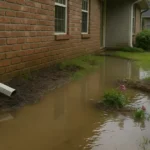
- Standing water or soggy soil within the first few feet of the slab
- Mulch, soil or sod sitting higher than the ground a few feet out
- Patios or walks that hold water or slope back toward the house
- Water crossing into your yard from a neighbor’s lot
Take photos. They make it far easier to show a contractor, or your builder if the home is still under warranty, exactly where the water goes. Our pre-storm gutter checklist covers what to inspect before the next squall line.
Common Questions About Standing Water Around Walker Foundations
These are the questions Walker and Livingston Parish homeowners ask when water starts collecting along the slab. The answers draw on Louisiana’s building code, USDA soil data and NOAA rainfall records.
Why does water collect next to my new house in Walker?
Usually because the soil drains slowly and the roof water lands right at the slab. Common Livingston Parish soils are poorly or somewhat poorly drained, with water perched close to the surface all winter. Downspouts that end beside the foundation put water exactly where it cannot soak in.
How far should the ground slope away from my foundation?
The 2021 International Residential Code, enforced in Louisiana and in Walker, requires the ground to fall at least 6 inches within the first 10 feet. The same section calls for patios, walks and driveways within 10 feet of the house to slope at least 2 percent away from it.
How far from the house should downspouts drain?
The residential code sets discharge at least 5 feet from the foundation, or into an approved drainage system, where expansive soils exist. On slow-draining Livingston Parish ground, 5 feet or more is a sensible target, and underground lines can carry water farther.
Is standing water after rain normal in Walker?
Some brief ponding in low parts of the yard is common on slow-draining soil. Water that stands against the slab, or lingers for days, is not something to ignore. It points to a grading or downspout problem worth fixing before it causes damage.
Does a new house have to meet drainage rules?
Yes. Walker applies the 2021 International Codes with Louisiana amendments to projects submitted since January 1, 2023, and the residential code requires lots to be graded to drain water away from the foundation. If your home is newer, ask your builder if it is still under warranty.
Will longer downspouts fix standing water by the foundation?
Often, yes, when roof water is the main source. Extending or burying the discharge moves the largest single volume of water away from the slab. If the ground itself has settled or been built up, the grade also needs to be corrected.
Move the Water, Then Protect the Slab
Standing water at the foundation is almost always a water path problem, and the roof is the biggest source you control. As a firefighter-owned company with over 12 years of experience, we install and extend downspouts across the area, including our downspout installation service in Walker and gutter installation for Walker homes. See more of our work in the project gallery, or learn about the areas we serve around Walker.
Ready to get the water away from your slab? Tell us what you see after a storm, and we will show you where it needs to go, with a clear quote and no surprises.